UX Leadership
Transforming a Fragmented UX Function into a Unified Enterprise Design Organization

Context
When I joined Boeing Digital Aviation Solutions (DAS) Design, it was the largest and most mature UX organization within Boeing. Our director was expanding its scope to support UX across Boeing Global Services—including Product Management and Technology Solutions (PM&TS) within Training Solutions, which developed software used to train commercial, military, business, and general aviation personnel.
UX within Training Solutions was fragmented and lacked formal leadership. Seventeen designers were distributed across four portfolios, reporting to ten different managers—none with design backgrounds. Several designers were assigned through a separate internal staffing organization, further diffusing accountability.
This environment created significant challenges:
No centralized UX leadership or career development
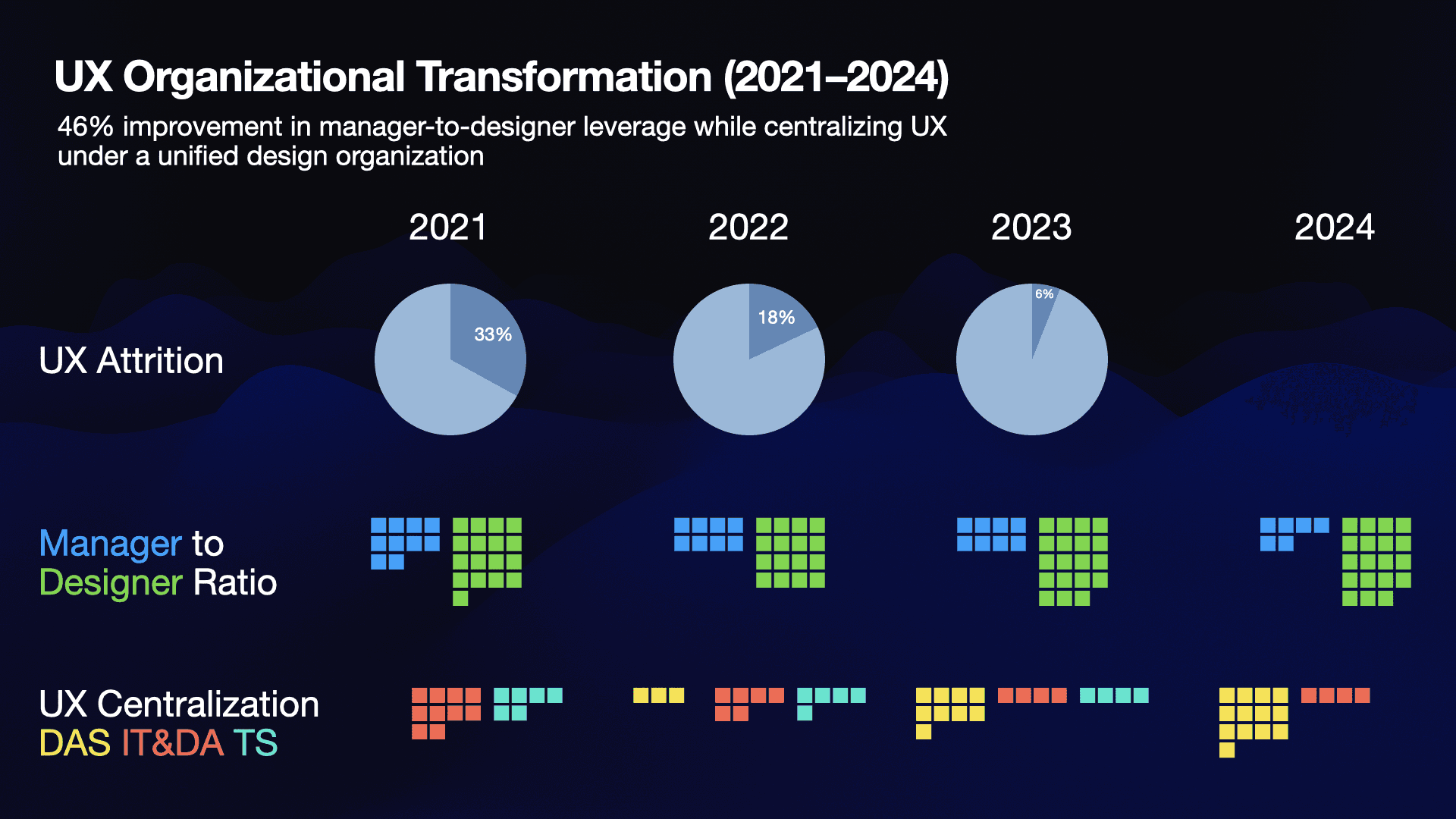
High attrition, with 33% designer turnover in one year
Inconsistent design quality and processes across portfolios
Limited coordination between teams, resulting in duplicated research and customer fatigue
Multiple competing design systems across portfolios, creating inconsistency and duplication
Design was largely used tactically, focused on interface execution rather than shaping product direction. Leadership had limited exposure to modern UX practices or how design could reduce risk, clarify product strategy, and enable innovation.
I was tasked with improving design effectiveness and integrating Training Solutions designers into the centralized DAS Design organization.
Objective
The goal was to transform UX within Training Solutions into a coordinated, professionally led design organization aligned with enterprise standards.
Specifically, I aimed to:
Reduce attrition through mentorship, leadership, and career development
Establish centralized UX leadership and clearer reporting structures
Improve collaboration and consistency across portfolios
Integrate designers into enterprise design systems, tools, and practices
Increase design’s strategic influence on product direction and planning
Approach
I led this transformation through organizational mapping, leadership alignment, designer mentorship, and gradual operational integration.
1. Establishing Organizational Clarity
I met with leaders across Training Solutions to understand product portfolios, team structures, and business priorities.
To create shared visibility, I built a comprehensive visual map of the organization in InVision Freehand, documenting:
Product portfolios and teams
Individual products and their lifecycle status
Reporting structures
Design staffing distribution
This became a widely used reference for leadership discussions and onboarding, helping establish a shared understanding of the organization.
2. Mentoring Designers and Building Community
Designers lacked mentorship, career guidance, and connection to a professional design organization. I met individually with each designer and established ongoing mentorship.
I also created cross-portfolio UX forums where designers could share work, coordinate research, and support one another. Training Solutions designers were integrated into DAS critiques, working groups, and learning programs.
In parallel, I coached UX leads on stakeholder engagement and strategic communication, enabling them to contribute earlier and more effectively within their product teams.
3. Establishing Leadership Alignment and Operational Coordination
To integrate UX into organizational decision-making, I established regular coordination forums with leadership and engineering, including:
Cross-portfolio UX leadership forums
Monthly reviews with the Training Solutions director and portfolio leaders
Ongoing alignment with engineering leadership
Coordination with internal staffing managers
These forums improved transparency, strengthened trust, and positioned UX as a strategic partner rather than a downstream service.
4. Elevating Design’s Strategic Influence
As relationships strengthened, designers became involved earlier in product definition.
In one case, a designer worked directly with senior leadership to translate an abstract product concept into concrete interface visions. Iterative design exploration clarified requirements and feasibility, enabling the organization to move forward with a strategically important new product.
This demonstrated how design could accelerate decision-making and reduce ambiguity.
5. Integrating Enterprise Design Systems and Tooling
I connected Training Solutions teams to enterprise design initiatives, including:
Adoption of the Atmosphere enterprise design system
Migration to Figma and modern collaborative workflows
Participation in DesignOps programs and training
Integration with CX analytics for product measurement
This improved consistency, collaboration, and alignment with Boeing’s broader product ecosystem.
6. Centralizing Hiring and Management
Initially, leadership was hesitant to centralize UX reporting. I began by supporting hiring efforts: modernizing job descriptions, evaluating candidates, and advising portfolio leaders.
As trust grew, leadership transitioned hiring authority to me. Over time, designers began reporting into the centralized UX organization, enabling consistent leadership, career development, and performance management.
UX evolved from a fragmented staffing model into a coordinated, professionally led discipline.
Outcomes & Impact
Over four years, this effort transformed UX within Training Solutions into a stable, strategically engaged organization.
Key outcomes:
Reduced UX attrition from 33% to 6%
Centralized UX leadership and established clear reporting structures
Improved designer-to-manager alignment and team stability
Enabled adoption of enterprise design systems and Figma across portfolios
Established regular executive and engineering alignment around UX
Improved cross-team collaboration and reduced redundant research
Elevated design’s role from tactical execution to strategic product partner
Enabled designers to directly influence product direction
Following this transformation, Training Solutions formally established a dedicated UX management function, reinforcing the long-term value of centralized design leadership.
My Role
I led the transformation of UX within Training Solutions, defining and executing the strategy to stabilize, scale, and integrate the design function.
Responsibilities included:
Defining the organizational integration strategy
Mentoring designers and developing UX leadership capability
Leading hiring, staffing, and performance management
Establishing executive and cross-functional alignment
Introducing enterprise design systems, Figma, and DesignOps practices
Improving collaboration, research coordination, and design consistency
Advocating for design’s role in product strategy and innovation
This work transformed a fragmented, high-attrition function into a cohesive, strategically engaged UX organization.
82%
Reduction in UX attrition
46%
Improvement in manager leverage
76%
UX centralized under design leadership